
Understand & measure
Measure generation, consumption, temperatures and charge levels at suitable points.
Energy management · System design
We plan the heat pump, photovoltaics, battery storage and charging together. Your building’s heating needs, electricity consumption and future uses determine how the system is controlled.
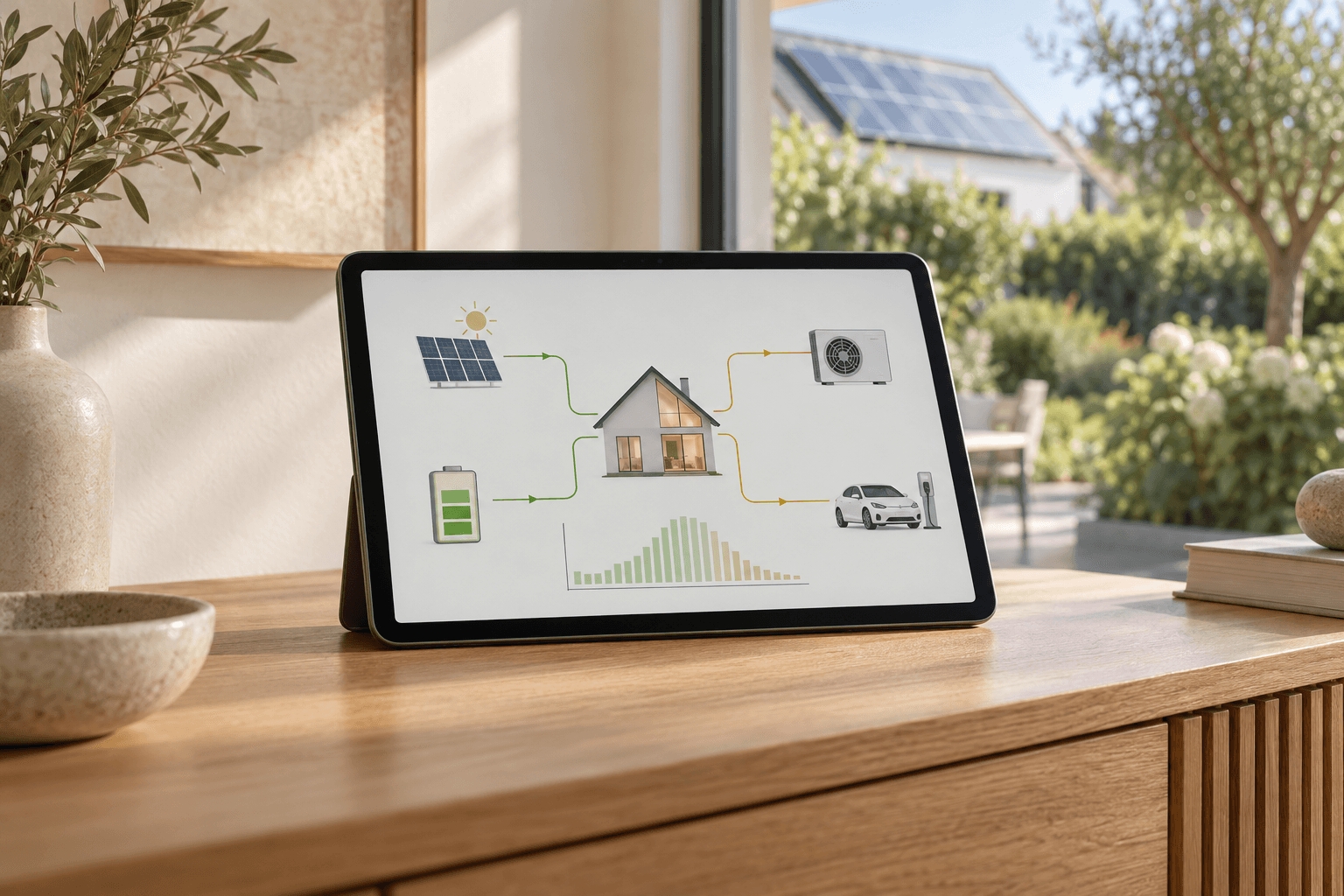
01 / Energy management
Explore example operating strategies. Comfort, equipment requirements and available energy set the limits; priorities are defined for your building.
Solar surplus
The system considers current consumption, heating demand, battery charge and charging targets. Flexible loads can be shifted within their operating limits.
Design example · not live data or a savings calculation
02 / What we assess together
A dashboard displays data. For a working system, we also design measurement points, interfaces and clear operating rules.
Measure generation, consumption, temperatures and charge levels at suitable points.
Consider usage schedules and, where supported, generation forecasts.
Coordinate heating, storage and charging around defined priorities.
Present measurements and operating states clearly and adjust settings when needed.
03 / Your application
The right controls follow from the project. We assess existing equipment and planned extensions together, independently of the manufacturer.
Match the heat pump, solar, battery and vehicle to everyday household needs.
Comfort schedules, hot water, charging targets and available interfaces.
Plan shared energy supply around different users.
Metering structure, common loads, central heat pump and a separate billing solution.
Coordinate operating hours, charging points and, where relevant, heat pump cascades.
Load profiles, connection capacity, operational priorities and economic objectives.
Assess existing equipment and plan suitable extensions.
Device models, software versions, measurement points and supported functions.
Match solar surplus and charging demand with other loads.
Departure times, charging power, expandability and heating priorities.
Assess mobile PV, storage and changing loads as one system.
Operating profiles, communication, available sources and connection-loss behaviour.
04 / What we assess together
A shared brand does not guarantee every function. We check actual devices, software versions and supported controls before selection.
EEBUS, Modbus or SG Ready can enable different functions depending on the device. An interface name alone is not enough: we check the specific combination and its approvals.
We define required measurements, responsibilities and access. For multiple users, operational data and billing are assessed separately.
We check which functions work locally and which require cloud services. Behaviour during internet or communication loss is part of commissioning.
Time-varying tariffs can guide controls with a suitable contract and system. We assess total costs, losses and comfort; cheaper hours do not guarantee overall savings.
05 / Energy management · System design
We calculate heating demand, expected heat pump electricity use and PV self-consumption to size the equipment. Controls put this design into practice.
Define heating requirements and operating limits.
02Calculate generation and directly usable solar energy.
03Plan capacity, power and reserves together.
Energy management does not create additional energy. Winter heating needs, summer PV generation and available storage capacity remain decisive.
06 / Plan my complete system
Assess the building, heating needs, electricity profiles and future uses.
Compare heat pump consumption, PV self-consumption and technical and economic options.
Select components, define metering and priorities; review potential funding for the project.
Coordinate implementation, verify functions and fallback behaviour, and explain operation.
With suitable devices, metering and tariff integration, it can shift flexible consumption. We assess comfort limits, final prices and price risk. A dynamic tariff does not guarantee savings.
Affected controllable loads in Germany need to accommodate grid control. The operator and electrician determine the connection; the EMS must respect instructions and equipment limits. Electricity tariffs and network-charge arrangements are assessed separately.
Not necessarily. Verified compatibility and supported functions are what matter. We select the combination for the building’s needs.
Not automatically. Controls, metering and billing are different tasks. We explicitly plan how they work together for apartment buildings.
Energy management alone does not provide backup power. Suitable storage, inverters and switching are required; supported loads are defined separately.
Energy management
Tell us about your building, existing equipment and desired functions. We will assess a technically and economically suitable system design.
Your email app opens with your selection. Complete the details before sending.